who we are
Sienos Grupė is a grass-root initiative that emerged in the autumn of 2021 in response to the humanitarian crisis and urgent need for assistance at the Lithuanian – Belarusian border. Initially formed by concerned citizens, the group focused on providing direct humanitarian aid to people affected by the push-back policies at the external Schengen border.
In 2022, as its activities expanded, Sienos Grupė was formally established as a non-governmental organization. Its work grew beyond emergency humanitarian support to the fields of political advocacy and assistance to foreign nationals navigating life in Lithuania. Since 2024, the organization has been running a social center in Vilnius, serving as a hub for its activities and community engagement. In 2025, Sienos Grupė became a member of the international network PICUM.
Mission - serve the public interest by carrying out activities of public benefit related to the monitoring of migration policies and the protection of human rights in the context of irregular migration, with a particular focus on combating racism and safeguarding the rights of individuals seeking international protection in border areas, asylum seekers, as well as persons whose asylum applications have been rejected but who have not been removed from the Republic of Lithuania.
ojectives and tasks
Protection and integration of the rights of foreign nationals
Protection of human rights
Promotion and organisation of voluntary activities
Development of civic and cultural identity
Public awareness-raising
articles of association
founders
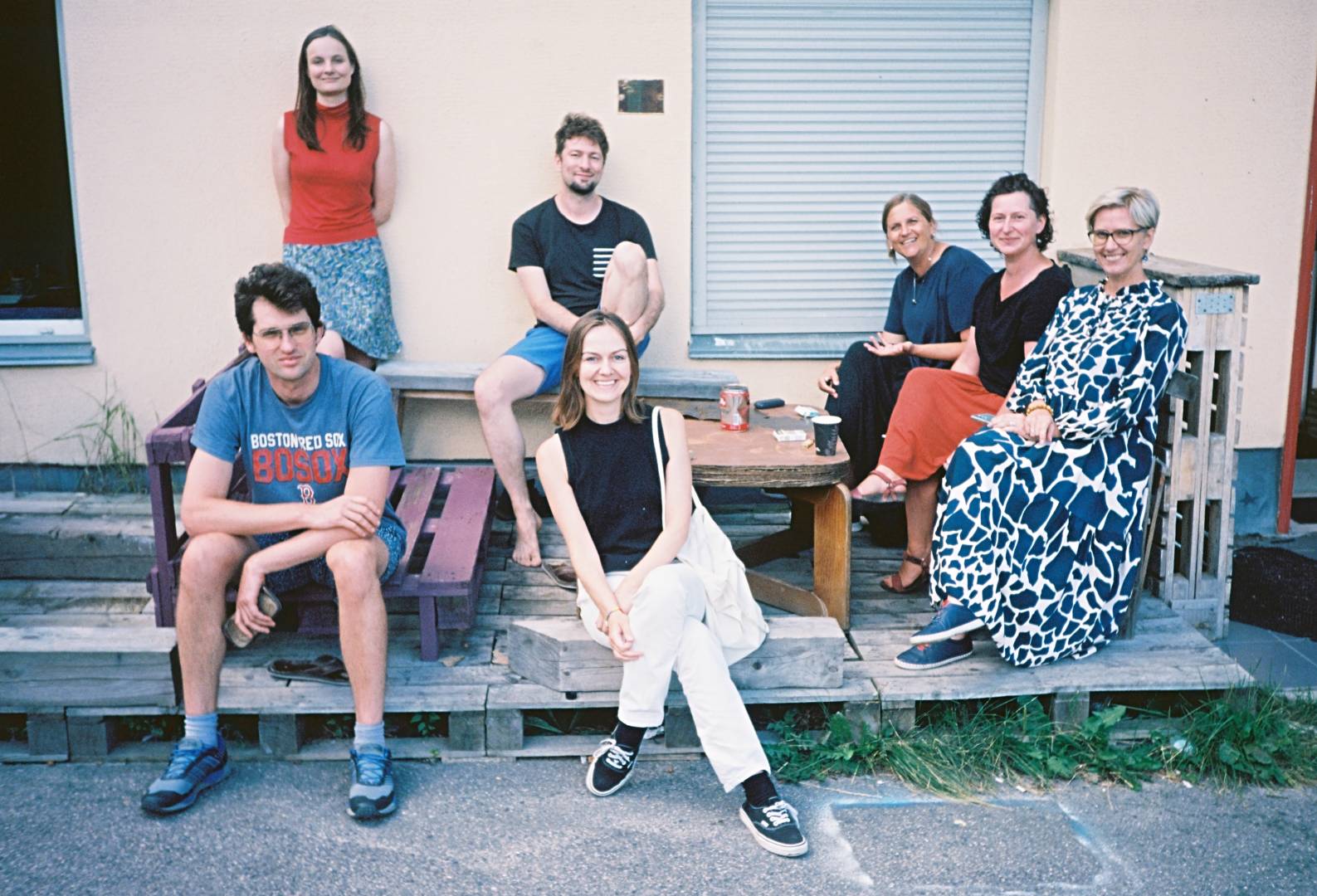
Sienos Grupė as a grass-root initiative was inspired and initiated in the autumn of 2021 by three women — two named Rita and one Vaiva. Immediatly, the initiative was joined by several dozen active volunteers and a growing circle of committed supporters. After the first intensive year of activities, nine members of the group officially established a non-governmental organization, Sienos Grupė.
Aušrinė Gogelytė
Rita Augutienė
Eligija Butkutė - Tamulienė
Julija Kėkštaitė
Eva Kolodziej
Ugnė Katarskė
Rita Škriadaitė - Vrubliauskė
Mantautas Šulskus
Emilija Švobaitė
Vuk Vukotic
history
Autumn 2021 in Lithuania.
The weather is getting colder. Lithuania “defended itself against a hybrid attack” by legalising push-backs of migrants at the Lithuanian-Belarusian border by the Order of the Minister of the Interior. The camps used to imprison around 4,000 migrants who came across the border from Belarus in the summer of 2021, before access to Lithuania was closed.
Polish activists have consistently shared information publicly about the push-backs by officers at the Polish-Belarus border. Children, the elderly, the disabled, stranded for long periods of time in inhumane living conditions, without food and water. Exhaustion and trauma caused by the confrontation with the officers resulted in the first deaths at the border.
The Polish border with Belarus is 418 km long.
The Lithuanian-Belarusian border is longer - 679 km.
But in Lithuania, information about migration at the border was kept completely secret. Silence. However, this silence was not acceptable to a few people who suspected that the processes taking place in Poland were being repeated in Lithuania.
Ewa, a Polish woman living in Lithuania, used to receive information from Polish volunteers about people in Lithuania who needed urgent medical or humanitarian assistance. Rita S., who observed the humanitarian activities of Polish volunteers, witnessed the most difficult and inhumane situations in the forests in Poland. After meeting on social media, the women started to gather people who wanted to know the truth about the border and to help people not to die on the Lithuanian territory.
This led to the development of an initial humanitarian response plan at the end of October 2021, and in November 2021, the “headquarters” or “base” was established - a place where volunteers have been on call 24/7 for over a year to organise vital humanitarian missions to the border.It was not only Lithuanians who volunteered - we were joined by French, British, Turkish, Dutch, Danish, German, Serbian, Portuguese, Polish, Swiss, and other EU nationals. Engineers, teachers, physicists, lawyers, philologists, architects, social workers, psychologists, artists, medics, translators, journalists, entrepreneurs, managers, lecturers, students - these are the people who have responded to the call for help.
Help that our government forbade to provide.
Because of the propaganda that flourished in the information vacuum, we avoided telling our family and friends about volunteering. Most officials and politicians demonised our activities, calling us “Putin's useful idiots”, “Lukashenko's agents”. The public, unfortunately, echoed this, not understanding why we help migrants. But we were only bringing food, water, medicine, we were only dressing wet children, attending to injured legs... Seeing the situation and in order to publicise the severe inhumane crimes that were being carried out in secret, we started contacting journalists and politicians.
We've been fined for saving a life. We filed our first applications to the European Court of Human Rights (ECtHR) for interim measures. The ECtHR ordered Lithuanian officials to let people in and accept their asylum applications. We learned by doing. We have pulled a dozen more people out of death's clutches. We were soon charged with people smuggling, but soon acquitted - the pre-trial investigation was dropped.
This was the beginning - we thank the Forum for Christian Social Initiatives (www.ksiforumas.lt) for hosting us in the beginning and giving us the opportunity to have a legal status. The legal status allowed us to mobilise even more people who were not physically able to contribute to the activities, but who could support financially.
In the summer of 2022, nine volunteers set up a separate organisation called Sienos Grupe, which was officially registered in autumn 2022.
It is not easy to remember. Especially those whose requests for help we have not been able or allowed to respond to. It was especially scary to go to the wives lying on the ground - because every time we thought “if only he hadn't died”... As the volunteers still say today - the forest will never be just a forest anymore - when we walk we will always be looking for people who are scared and hiding. We will see more than others see. We will listen more carefully.
„...overnight temperatures in recent days have reached their lowest level since summer, and not a single person has been allowed in out of 263 people who have tried to cross the border in the last 4 days. Somehow I had hoped that when the weather dropped, at least a few people a day would be “spared”. Not a single person who had not eaten for several days, neither a child nor a woman, was identified as vulnerable. A clear demonstration of who holds the power. And a penalty for telling the truth.”
(from volunteer's notes, Autumn 2021)